
The stock market continued its downward journey on Friday, after a brief recovery Thursday, wiping off 746.4 points (5.48 per cent) on the bellwether BSE Sensex during the week, the biggest weekly loss in seven months.

A lot of mid and small-caps are in the bubble zone and command high valuation and have corrected sharply.

Market players said the sell-off was triggered by pessimism that the government may not be able to balance growth with macro-stability.

When the bull run begins its march again, it will really be different!

Small-cap stocks raked in big gains in fiscal 2021-22 by giving up to 36.64 per cent returns, outshining the bigger benchmark gauge and experts believe that they may continue to outperform in FY23. Markets faced many headwinds in the latter part of the last fiscal with the emergence of geopolitical tension, inflation concerns and FII selling. Analysts said that the first half of the last fiscal was very good, while the market entered into consolidation in the second half, combined with high volatility.

Benchmark indices bounced back on Wednesday after falling for five straight sessions, with investors snapping up the recently-mauled IT, finance and consumption stocks amid a supportive trend overseas. A rebounding rupee further bolstered sentiment, traders said. Halting its five-session slide, the BSE Sensex jumped 574.35 points or 1.02 per cent to finish at 57,037.50. Similarly, the NSE Nifty surged 177.90 points or 1.05 per cent to 17,136.55.

Passenger vehicle wholesales saw a marginal growth of 4 per cent in June on account of high base effect and muted demand due to severe heatwave conditions in several parts of the country. Overall passenger vehicle dispatches last month stood at 340,784 units, a growth of 3.67 per cent compared with 328,710 units in June 2023.

Given the developments, analysts expect fiscal and monetary support from the government and RBI to revive sentiment. However, recovery, they say, from these levels will be slow and painful.

Marking a significant improvement in their attitudes, a higher percentage of global executives feel the economy is recovering and 71 per cent think the stock market will continue to improve in the second half of 2009.

If you ignore market upheavals and stay the course, you end up making money, says Larissa Fernand
The BSE Sensex bounced back by 14.8 per cent (2,261.65 points) from Tuesday's intra-day low of 15,332.42 to close at 17,594.07 on Wednesday. The index, which lost 5,874.35 points from its all-time high of 21,206.77, has retraced 39 per cent of its total losses.

Benchmark indices Sensex and Nifty retreated from over one-week highs to close lower on Wednesday due to profit booking in banking, IT and metal stocks amid weak global trends. After a two-day rally, the 30-share BSE Sensex dropped by 90.99 points or 0.16 per cent to settle at 57,806.49 in volatile trade. As many as 19 of its constituents declined while 11 advanced. The broader Nifty slipped by 19.65 points or 0.11 per cent to close at 17,213.60 with 31 of its stocks ending in the red.

The benchmark National Stock Exchange Nifty has rallied 4 per cent, or 750 points, from this month's low to end at 19,732 on week ending November 17. Technical analysts say the market could consolidate around the current levels as it is nearing the resistance zone. "The near-term uptrend status of the market remains intact, but there is a possibility of some more consolidation or minor weakness for the Nifty in the next one to two sessions.

The markets have been unable to sustain at higher levels as a rise in bond yields globally, especially in the US have dented sentiment. Surging commodity prices, especially crude oil that have now hit $70 a barrel (Brent) coupled with inflation woes and fear of sporadic lockdown across major economic hubs back home as Covid cases rise have chased the bulls away. In the short-term, analysts expect the markets to remain volatile as they react to news flow - both from overseas and developments back home. Investors, they say, need to keep a tab on how the US treasury yields move, which in turn will have a ripple effect on how big money moves across developed (DMs) and emerging markets (EMs), including India.

Titan was the top gainer in the Sensex pack, soaring nearly 7 per cent, followed by ONGC, L&T, Kotak Bank, Axis Bank, Bajaj Finance and HDFC Bank. NSE Nifty soared 114.15 points to end at its lifetime peak of 15,690.35.

The global billionaires list witnessed as many as 94 new entrants from India, stated a report by Hurun India on Tuesday. Following a net addition of 84, the country's billionaire tally touched 271 with their combined wealth at $1 trillion, noted the report. Mukesh Ambani, chairman & managing director of Reliance Industries, is the only Indian to make it into the top 10 of the Hurun Global Rich List 2024, a ranking of billionaires in US dollar terms.

With sentiment for the automotive (auto) sector turning positive, stocks of two-wheeler auto majors have been hitting their 52-week highs. Hero MotoCorp, Bajaj Auto, TVS Motor Company, and Eicher Motors recently reached their yearly highs on strong sales in the festival season and the expectation of faster growth rates ahead. Since the start of this month, listed two-wheeler majors have delivered returns in the 12-17 per cent range, compared to the 7 per cent gains for the S&P BSE Auto Index and 3 per cent for the benchmark S&P BSE Sensex.

Gold demand appears to be positive in India as the consumer sentiment is likely to recover in 2021, from its dismal performance due to the coronavirus pandemic-related disruptions and volatile price movement, according to a report by the World Gold Council (WGC). Initial data about the Dhanteras festival in November suggest that while jewellery demand was still below average, it had substantially recovered from the lows seen in the second quarter (April-June 2020) of last year, according to the report.
.jpg)
BSE auto index surged 2%, capital goods, healthcare and oil & gas indices also up.

Led by Trent, which hit its lifetime-high recently, apparel retailers have gained between 10 per cent and 36 per cent over the past three weeks. Given the network of physical stores, these stocks shall be major beneficiaries of the unlock theme, with most states doing away with Covid restrictions. Amid improving footfall, analysts expect the sector to post double-digit growth in FY23.

'Stick to the known quality names, avoid short term thinking and don't be in a hurry to book profits on your winners.'

The market could not make a clear assessment of Tech Mahindra with the stock swinging wildly in the last two sessions. The results on Thursday were expected to be weak but the stock dropped slightly. However, investors reviewed the three-year turnaround plan and decided the stock had been oversold and the price recovered 7.5 per cent.

HUL, UltraTech, Asian Paints, L&T, HDFC Bank top global valuation charts

Vodafone Idea's (Vi's) subscriber loss reduced to a seven-month low in March, and alongside the company added 1.1 million broadband users after two months of net loss -- two things analysts have noted as key trends that need to be monitored. While Vi has been losing customers for more than two and a half years now, the churn reduced to below a million after five straight months in March, the Telecom Regulatory Authority of India (Trai) data has shown. "Jio's softer than usual subscriber growth in March, and VIL's slowing subscriber market share loss are key trends to keep an eye on going forward," global investment banking and financial services major UBS said in an analyst note.
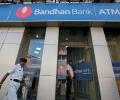
Bandhan Bank has declared disappointing results for the first quarter of the 2023-24 financial year (Q1FY24). While the market has been braced for known issues around microfinance exposures in West Bengal and Assam, there is higher stress in the portfolio. This means higher credit costs and poorer asset quality, leading to target downgrades by analysts.

The FMCG sector is generally considered to be a safe haven during difficult times as people never stop buying soap and toothpaste. However, weak rural and semi-urban demand has been a factor since the lockdowns of 2020-21 while rising inflation has also impacted margins. While the FMCG majors have survived on the basis of price hikes and good management practices, they have seen growth slowdowns and experienced margins being squeezed as raw materials and transport costs rose. The FMCG sector witnessed positive volume growth in the fourth quarter of the 2022-23 financial year (Q4FY23) after five consecutive quarters of decline, and the rebound in demand was led by urban markets.

Industrial metals (ferrous and non-ferrous) suffered great volatility once the Ukraine War began in February 2022. First, there was a sharp price rise due to fears of supply disruption, followed by weak global demand. China's weakness and rolling lockdowns have hit production and demand.

Out of 11 companies that got listed in 2019, nine have outrun the market by gaining more than 10 per cent against their respective issue price.

If you think that revenue officials are going berserk, acting on their own, while the government chants the mantra of 'ease of doing business', you would be wrong. These moves appear to have full official backing, points out Debashis Basu.

Markets ended higher, amid firm global cues, and are on track for third straight day of gains.

M&M was the biggest gainer in the Sensex chart, rising 6.51 per cent, followed by NTPC, PowerGrid, SBI, HDFC Bank, Asian Paints and Wipro. In contrast, Axis Bank, ITC, HUL, Nestle India and Sun Pharma were among the laggards.

Finance Minister Nirmala Sitharaman on Thursday said the government is close to reaching saturation in implementing social sector schemes designed to provide basic necessities to the poor. Addressing the students of Hindu College on the occasion of its 125th anniversary, she said the time has come for India to become economically 'aatmanirbhar' (self-reliant) and march forward to becoming a developed nation by 2047. Regretting that 60 years since Independence passed without any sense of urgency, Sitharaman said, "We have laid the material foundation for a Viksit Bharat" and empowering people by providing basic necessities to all.

'The variables to watch include the monsoon, resolution of NBFC liquidity issues, GST collections, and NPA resolution.'

And, of course, create wealth over the long-term

At the BSE, 1,552 stocks advanced, while 1,419 declined and 118 remained unchanged.

ITC stock slipped over 4 per cent on Thursday (February 8) after British American Tobacco (BAT) said it could sell some of its stake in the company, recovering partially in trade. The stock of the cigarette-to-hotels conglomerate traded at Rs 420 levels, rising 1.3 per cent in intraday deals as compared to the S&P BSE Sensex that traded flat for most part of the day. The development, meanwhile, saw Jefferies downgrade the stock to 'hold' from 'buy' earlier with a target price of Rs 430, down a huge 17.3 per cent from its earlier price target of Rs 520.
Titan was the top gainer in the Sensex pack, rising over 3 per cent, followed by M&M, Reliance Industries, Axis Bank, TCS, Maruti and Infosys. NSE Nifty surged 122.10 points to 15,885.15.

ITC, Sun Pharma, Maruti, M&M, Tata Motors, HCL Tech, Wipro, Infosys, HUL, Bharti Airtel and Reliance were among the major losers. Kotak Bank rose the most by 1.59 per cent, followed by IndusInd Bank, Bajaj Finance and Bajaj Finserv. L&T, SBI, TCS and HDFC Bank also closed higher.

Experts said banking is a play on the economy and the latest buying into this space is underpinned by hopes of a sharper-than-expected recovery in the economy.

Tata Steel was the top gainer in the Sensex pack, rising around 5 per cent, followed by Bajaj Finance, Bajaj Auto, HDFC, HCL Tech and Titan. On the other hand, Maruti, ONGC, IndusInd Bank and Tech Mahindra were among the laggards.
 © 2026 Rediff.com - Advertise with us - Disclaimer - Privacy Policy - Sitemap - Feedback - About us - Terms of use - Grievances